Current Lab Projects
Thursday, December 17, 2009 at 4:07PM Currently in the Kucenas Lab, we have 6 general areas of research that we are actively pursuing. Read below to find out a little bit more about each!
Glial Cell Migration
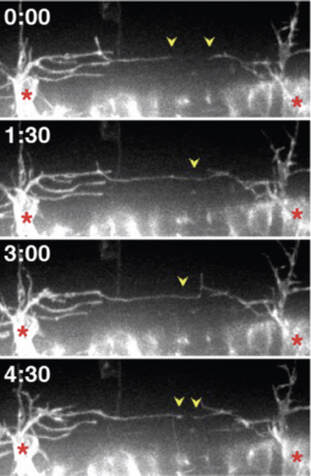
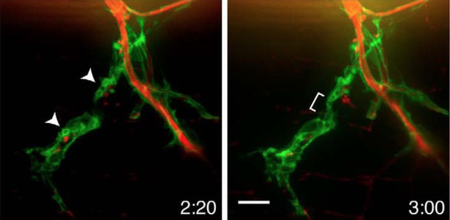
Like many cells during development, peripheral glia are often born great distances from their sites of differentiation. They must migrate from their place of birth to very specific locations in the peripheral nervous system (PNS) where they interact with axons and other glia at distinct developmental stages to ultimately help sculpt and maintain the nervous system. Aberrant glial migration is a feature of many human disorders including invasive glial cancers where migration is left unchecked and spinal cord injuries where glia actually hamper axonal regeneration by blocking axon outgrowth and migration through glial scars. Currently, we know very little about what controls glial migration in the PNS. A deeper understanding will not only answer questions about how the nervous system is formed, but is also sure to unlock the mysteries of some glial diseases and possibly alter how we treat certain disorders.
In the lab, we are very interested in 2 main types of glial migration: 1) the migration of perineurial glia out of the spinal cord (as seen above) and 2) the reciprocal interactions of Schwann cels and perineurial glia and their affect on migration of these two distinct glial populations.
Schwann Cell-Perineurial Glial Interactions
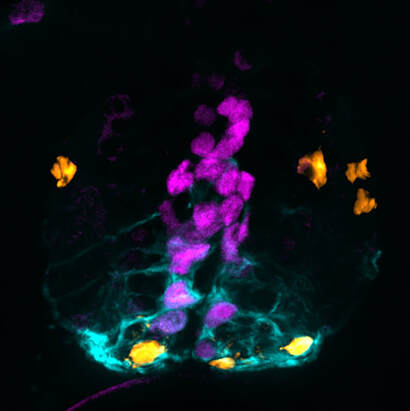
Schwann cells and perineurial glia are key components of all peripheral nerves. Schwann cells differentiate and ensheath axons in myelin whereas perineurial glia exit the spinal cord and ultimately form the mature perineurium. These glial cell populations must tightly coordinate their migration and differentiation to ensure the formation of functional peripheral nerves. In the lab, we use spinal motor nerves as models for investigating these interactions. Preliminary data demonstrates that these cell types communicate reciprocally during early development and that these interactions are essential for myelination of nerves. In the absence of either glial cell type, the other fails to differentiate.
In the lab, we're interested in unraveling a little more specifically the spatial and temporal map of when and where these two cell populations interact. Therefore, we have 2 main projects: 1) investigating to what extent perineurial glia require Schwann cells for their differentiation and 2) investigating whether Schwann cells require acute or sustained interactions with perineurial glia for their differentiation.
New Mutant Characterization
We know quite a bit about certain genes and their role in glial development in the PNS. However, we most certainly do not know every step from glial specification to terminal differentiation and therefore, as a post doc, I did a small pilot mutagenesis screen in zebrafish looking for mutants that had aberrant perineurial glial development. I identified 2 mutants, currently known as vu267 and vu268, that had distinct defects in perineurial glia along spinal motor nerves. We're very anxious to characterize these mutants and map the mutations to genes.
In the future, we're also planning a large scale mutagenesis screen to identify additional genes involved in PNS development.
On the Hunt For New Genes
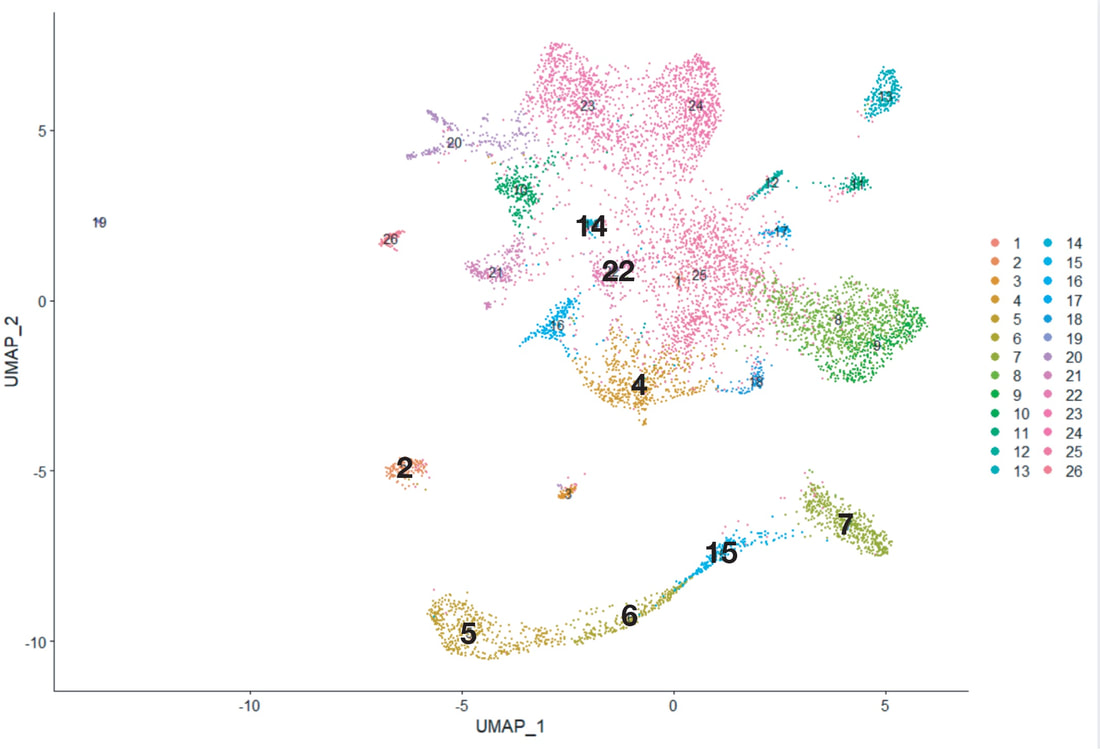
As mentioned above, Schwann cell-perineurial glial interactions are essential for development and maintenance of the PNS. However, we know very little about the molecular mechanisms that mediate these interactions. As a way to identify new players in these interactions, we are undertaking a transcriptome profiling approach utilizing wild-type larvae where all interactions are intact and comparing that data to mutant larvae where Schwann cell-perineurial glia interactions are absent. We hope to identify: 1) novel genes expressed by perineurial glia, 2) novel genes expressed by Schwann cells, 3) novel genes used by Schwann cells to interact with perineurial glia and 4) novel genes used by perineurial glia to reciprocally interact with Schwann cells.
Expanding Our Toolbox
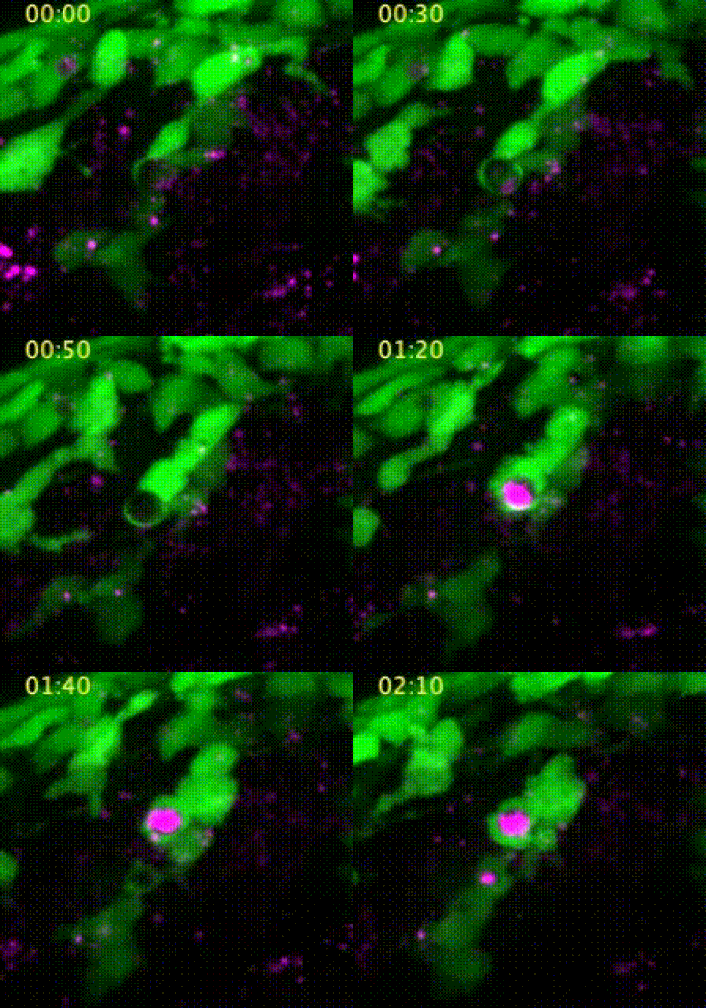
Currently, the main focus of the lab is investigating the role of glial cells in nervous system development and maintenance. However, in the future, we'd like to also understand the role of glia in disease and injury of the PNS. More specifically, we're interested in the role perineurial glia play in regeneration and cancer. To begin to set the stage for these types of questions, we're starting to create some new transgenic lines in the lab that allow us to genetically ablate different populations of glial cells at any stage of life.
Mammalian Perineurial Glia?
Are the origins of glia cells evolutionarily conserved? In Drosophila, the majority of peripheral glia originate from the lateral edges of the ventral nerve cord. In vertebrates, Schwann cells are neural crest derivatives that originate on the dorsal neural tube. The origin of the cells that make up the perineurium, however, has not been directly investigated until recently. In zebrafish, perineurial glia associated with motor nerves originate within the spinal cord and migrate out along motor axons. We hypothesize that like zebrafish, the cells that form the mature perineurium in mammals originate within the ventral spinal cord.
To investigate this hypothesis, we will use reporter lines in mice that label the ventral spinal cord.